
Information
Auctions
Catalogues
Community ♥
Banknote Catalogue / Reference entry

United Kingdom 10 Shillings – Elizabeth II, Series C (1961–1969)

United Kingdom · 1961–1969

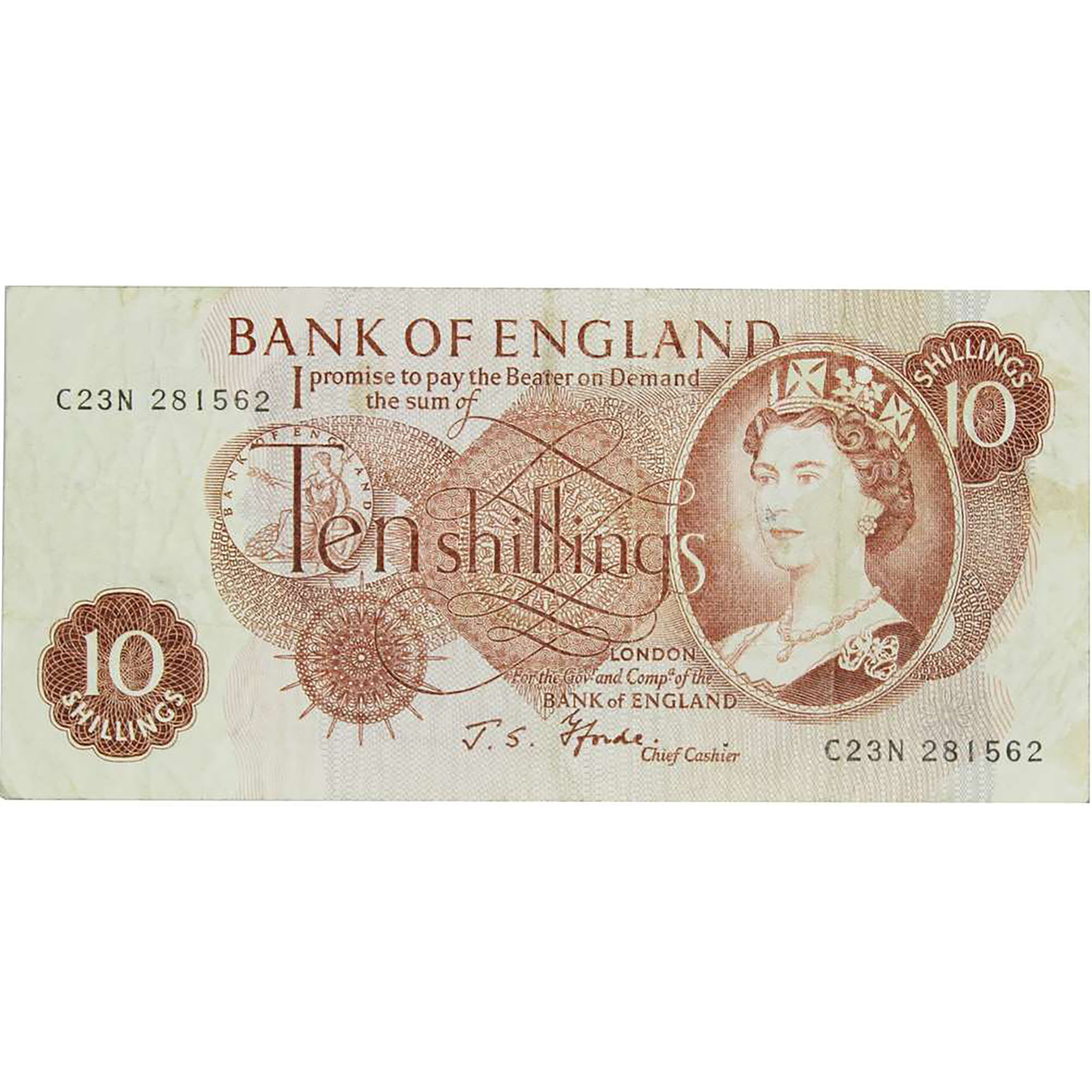
Front of banknote
ObverseSide 1
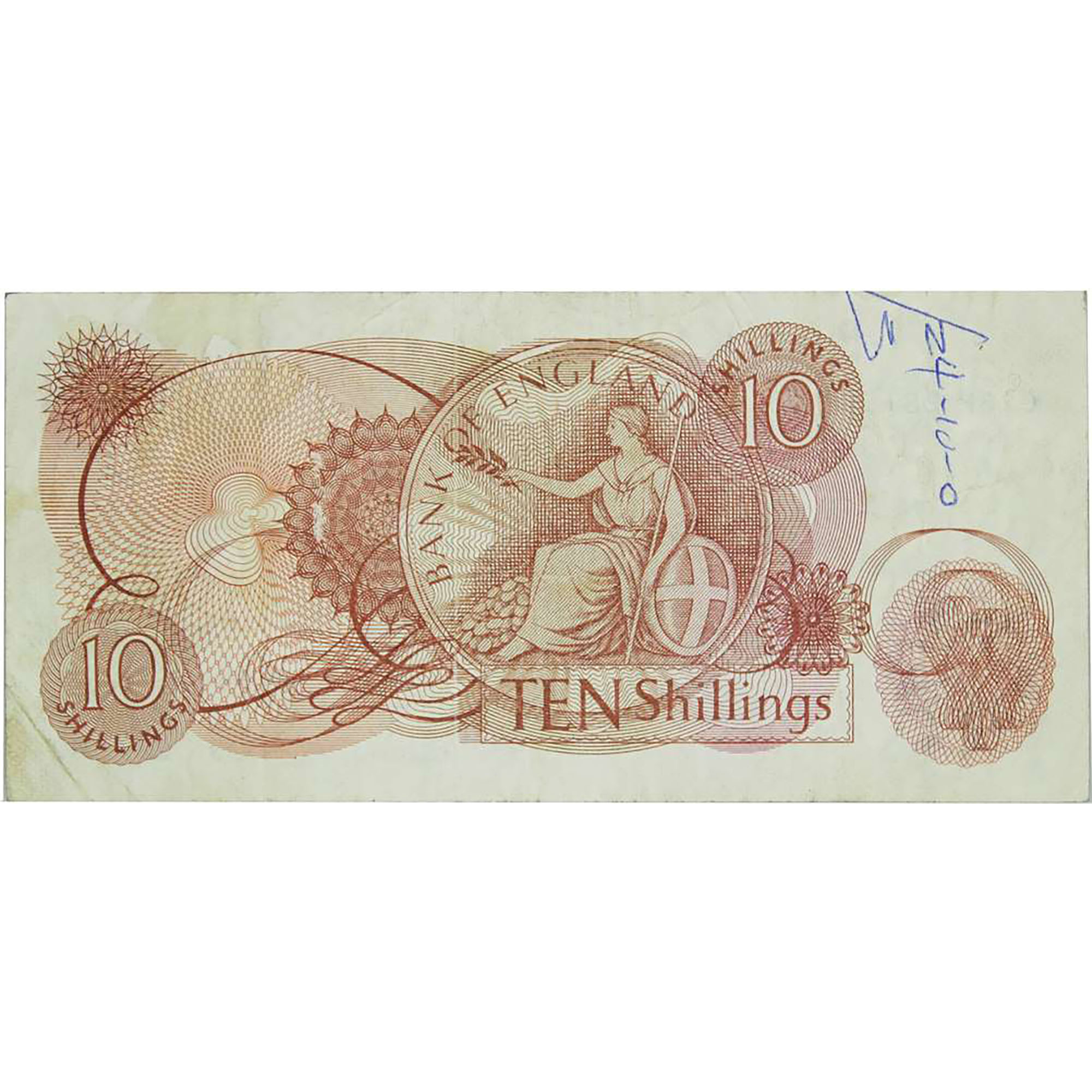
Back of banknote
ReverseSide 2

Catalogue overview

Banknote1961–1969United Kingdom

Series C ten-shilling notes are undated. Use the Chief Cashier’s signature and the position of the letters in the serial prefix to distinguish regular issues and replacement notes. The variants table identifies the issue shown in the photographs.

Issuing bank or authorityBank of England
Denomination10 Shillings (10/-; £½)
Series / issueSeries C – Portrait issue
Issue date / yearsUndated (ND); issued 12 October 1961 to 13 October 1969
Pick / catalogue numberPick P-373 (P-373a, P-373b, P-373c); EPM B286–B287, B294–B296, B309–B311
Paper / polymer / materialPaper

eBay links may earn an affiliate commission.

Identification guide

The Bank of England’s Series C 10 shillings banknote was issued from 1961 to 1969. Known as the ten-bob note, it was worth half a pound and was the only Bank of England ten-shilling design issued with a monarch’s portrait.

Obverse

What is depicted

Queen Elizabeth II and the Bank of England’s Britannia emblem

Design details

Queen Elizabeth II wears the Diamond Diadem in an oval frame on the right. A smaller seated Britannia is set into the bank’s circular emblem on the left. The value is written in flowing script across the centre. Denomination rosettes occupy the upper right and lower left, with the Chief Cashier’s signature below the payment promise. The serial number appears at the upper left and lower right.

Lettering

BANK OF ENGLAND C23N 281562 I promise to pay the Bearer on Demand the sum of Ten shillings BANK OF ENGLAND SHILLINGS 10 10 SHILLINGS LONDON For the Govʳ. and Compᵃ. of the BANK of ENGLAND J. S. Fforde. Chief Cashier C23N 281562

Reverse

What is depicted

Seated Britannia with a shield, spear and olive branch

Design details

Britannia sits in a circular medallion just right of centre, extending an olive branch. A shield bearing the Union flag rests beside her and a spear rises behind it. Interlaced guilloché patterns fill the surrounding field, with 10-shilling rosettes at the upper right and lower left. The blue handwriting on the photographed example was added after printing.

Lettering

BANK OF ENGLAND SHILLINGS 10 10 SHILLINGS TEN Shillings

Identity

Currency
Pound sterling (pre-decimal)

Design & production

Designer / engraver
Robert Austin; Harry Eccleston assisted with design details
Printer
Bank of England Printing Works, Debden, Essex, England
Printing method
Red-brown engraved design over a multicolour underprint on the obverse
Dimensions (mm)
140 × 67 mm (nominal)
Watermark
A vertical band of repeated laureate heads in profile at the left of the obverse, visible when held to the light.
Security features
An embedded metal security thread sits just to the right of centre. The obverse also carries two matching serial numbers.
Signatories
L. K. O’Brien; J. Q. Hollom; J. S. Fforde (Chief Cashiers)

History

Historical notes
The Bank of England first issued a ten-shilling note in 1928 as part of Series A. The newer Series C note kept the earlier note’s reddish-brown colour and approximately the same length, with a narrower format. Robert Austin used the same royal portrait on the Series C £1 note introduced in 1960. During preparations for decimalisation, the ten-shilling note was replaced by the seven-sided 50 pence coin in October 1969. The Royal Mint records that the paper notes lasted around five months in everyday use, so the coin offered a more durable way to carry the equivalent of half a pound. The note remained legal tender until 22 November 1970.
Withdrawal / demonetisation
22 November 1970 (ceased to be legal tender)

Documented variants

9 variants

Swipe sideways to view all columns.

Issue / yearSignature combinationSerial prefixSeries / variationQuantity / print runNotes
12 October 1961 (ND)L. K. O’BrienA01 (first prefix)Regular issueLetter followed by two digits.
1961 (ND)L. K. O’BrienM01–M18Replacement noteM-prefixed replacement series.
1963 (ND)J. Q. HollomK–Z letter groupsRegular issue – letter firstLetter followed by two digits.
1963 (ND)J. Q. HollomExample: 01ARegular issue – letter lastTwo digits followed by a letter.
1963 (ND)J. Q. HollomM19–M55Replacement noteContinues the M-prefixed replacement series.
15 February 1967 (ND)J. S. Fforde26R (first); suffixes R–ZRegular issue – letter lastTwo digits followed by a letter.
15 February 1967 (ND)J. S. FfordeA01N–D38NRegular issue – letter at each endThe photographed note is C23N 281562.
1967 (ND)J. S. FfordeM56–M80Replacement noteM80 is the final documented replacement prefix.
1961–1969 (ND)SpecimenSpecimen of the Series C type.